EN
EN 
In 2026, the procurement bar for food packaging has moved. Global retailers, quick-service restaurant chains, and corporate foodservice programs are no longer asking whether their packaging is eco-friendly — they are asking for documentation that proves it. Lunch box paper that cannot be traced to a responsibly managed forest source, verified through a credible chain-of-custody system, is increasingly being rejected at the supplier onboarding stage — before a single unit is ordered. For buyers sourcing paper lunch boxes wholesale, this shift means that FSC certification has moved from a differentiator to a baseline requirement for access to premium retail and foodservice channels.
The risk of getting this wrong is not abstract. A supplier that cannot provide FSC chain-of-custody documentation exposes the buyer to environmental audit findings, retailer delistings, and the reputational cost of sustainability claims that cannot be substantiated. Xiaolong's lunch box paper range — food-grade kraft paper boxes with ISO, FSC, SGS, and ROHS certification — is designed to support exactly this requirement: giving buyers the performance specifications and the sourcing documentation they need to qualify for high-standard accounts and pass environmental audits without friction.
FSC — the Forest Stewardship Council — is a certification system that supports responsible forest management and chain-of-custody traceability through every stage of the supply chain, from the forest where the fiber originates to the finished product that carries the FSC label.
FSC certification operates at two levels. Forest management certification verifies that the forest where the fiber is harvested is managed according to FSC's environmental, social, and economic standards — which include requirements for biodiversity protection, worker rights, and community engagement. Chain-of-custody certification verifies that the certified fiber can be traced through every processing and manufacturing step from the forest to the finished product, without being mixed with uncertified material in a way that breaks the traceability chain.
When a paper lunch box carries an FSC label — for example, "FSC 100%", which indicates that all fiber in the product comes from FSC-certified forests — it means that every organization in the supply chain between the forest and the finished product holds a valid FSC chain-of-custody certificate, and that the product's fiber content has been verified at each step. This is the documentation that retailers and foodservice operators require when they ask for FSC-certified packaging: not a general eco-friendly claim, but a traceable, auditable record of responsible sourcing.
The procurement requirements of major global retailers and foodservice chains have become more specific about what constitutes acceptable sustainability evidence. General claims — "made from recycled materials," "eco-friendly packaging," "sustainably sourced" — are no longer sufficient for supplier onboarding in channels where ESG reporting is a board-level commitment. FSC chain-of-custody documentation provides the specific, auditable evidence that these channels require: a certificate number, a scope that covers the product category, and a label that can be verified against the FSC public database.
For buyers sourcing lunch box paper for these channels, the practical implication is that a supplier without FSC chain-of-custody certification cannot provide the documentation required for onboarding — regardless of how good the product's physical performance is. Selecting an FSC-certified supplier eliminates this barrier before it becomes a problem.
FSC certification addresses the sourcing question — but the buyer also needs the product to perform in the application. A lunch box that leaks, deforms under heat, or produces inconsistent print quality generates customer complaints and returns that offset the brand value that the FSC certification was intended to support.
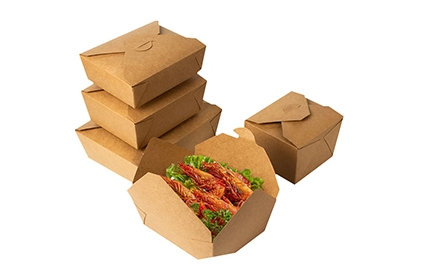
Xiaolong's paper lunch boxes are manufactured from Food Grade A kraft paper — the material specification that confirms the paper is safe for direct food contact and free from harmful substances that could migrate into food. Kraft paper provides the combination of strength, printability, and foldability that a converted lunch box requires: sufficient stiffness to maintain the box shape under the weight of a filled meal, sufficient surface smoothness for high-quality print reproduction, and sufficient fold performance to produce clean, tight corners without cracking.
The printing ink specification is a compliance requirement as well as a performance requirement. Xiaolong's lunch boxes are printed with CMYK and Pantone colors using EU eco-friendly inks — inks that comply with European food contact material regulations and do not contain the restricted substances that would create compliance problems in EU market channels. For buyers supplying European retailers or foodservice operators, this ink specification is a prerequisite for market access, not an optional upgrade.
The leak-proof design and secure lid concept address the most common performance complaint in disposable paper lunch box applications: food and liquid leaking through the base or sides of the box during transport. The heat-resistant material specification supports reheating scenarios — relevant for meal prep and delivery applications where the consumer reheats the food in the original container.
A lunch box that carries an eco-friendly claim without credible certification documentation creates a specific risk in 2026: platform and retailer audits that verify sustainability claims are finding that many "eco" claims are not supported by the documentation required to substantiate them. FSC certification, combined with food-grade material and compliant ink specifications, provides the complete compliance package that eliminates this risk.
Locking the correct specifications before mass production prevents the costly changes — artwork revisions, material substitutions, and compliance re-testing — that occur when specification decisions are deferred to the production stage.
| Specification | Xiaolong Standard | Buyer Action Required |
|---|---|---|
| Capacity range | 2.5oz, 3oz, 4oz, 6oz, 7oz, 8oz, 9oz, 10oz, 12oz, 16oz, 20oz | Confirm capacity matches portion size and food type |
| Material | Kraft paper, Food Grade A | Confirm food contact compliance for target market |
| Printing | CMYK and/or Pantone, EU eco-friendly inks | Provide artwork files; confirm color matching requirement |
| Branding | Logo per customer requirements | Provide logo files and placement specifications |
| Certifications | ISO, FSC, SGS, ROHS | Request certificate copies and CoC scope confirmation |
| FSC label | Available per FSC label use rules | Confirm label type required (FSC 100%, FSC Mix, or FSC Recycled) and placement in artwork |
FSC label use on finished products is controlled — the label must be applied correctly according to FSC's label use rules, and the supplier must hold a valid chain-of-custody certificate that covers the product category. When ordering FSC-labeled lunch box paper, confirm the following with the supplier before artwork approval:
The supplier's FSC chain-of-custody certificate number and scope — confirm that the certificate covers paper lunch boxes in the relevant product category. The FSC label type that applies to the product — FSC 100%, FSC Mix, or FSC Recycled — based on the fiber content of the specific material being used. The label placement and size in the artwork — FSC has specific requirements for label legibility and placement that must be followed for the label to be valid. The batch traceability documentation — invoices and delivery documents must reference the FSC certificate and the product's FSC claim for the chain of custody to be complete.
The business case for FSC-certified, food-grade lunch box paper is strongest in the channels where sustainability documentation is a procurement requirement rather than a preference — and where the cost of failing an environmental audit or losing a retail account exceeds the cost of the certification premium.
Quick-service restaurant and coffee chain supply chains are among the most demanding environments for lunch box paper performance and compliance. High throughput means that leak failures generate a large number of customer complaints quickly. Brand visibility means that print quality inconsistency is noticed and photographed. And the sustainability commitments that major QSR and coffee chains have made publicly mean that their procurement teams are actively verifying that supplier documentation supports those commitments. FSC-certified kraft paper with EU eco-friendly inks and a leak-proof design addresses all three requirements simultaneously.
Premium retail channels — specialty food retailers, department store food halls, and premium grocery chains — place the highest emphasis on FSC documentation and consistent print quality. These channels typically require FSC chain-of-custody documentation as a condition of supplier onboarding, and they conduct periodic audits to verify that the documentation remains current. A supplier that can provide FSC-labeled products with complete traceability documentation eliminates the onboarding friction that delays market entry and the audit risk that threatens account retention.
Events and corporate catering applications prioritize lightweight, portable packaging with easy customization for branding and event identity. The wide capacity range — 2.5oz to 20oz — covers the full range of portion sizes from snack servings to full meal portions, and the OEM logo capability supports event-specific branding without minimum order quantities that make customization impractical for single-event use.
Paper lunch boxes are flat-packed for efficient storage and transport, but they are sensitive to humidity and compression damage if stored incorrectly. Store flat-packed cartons in a dry environment away from direct contact with concrete floors, which can transfer ground moisture through the pallet base. Protect cartons from humidity exposure during storage — a box that has absorbed moisture before use will deform more easily under the weight of a filled meal and may not maintain its leak-proof performance. First-in-first-out stock rotation prevents boxes from sitting in storage long enough to absorb ambient moisture.
Standardize the packing procedure at the point of use — consistent fold and closure technique is as important as the box specification for leak prevention. A correctly specified box that is assembled incorrectly will leak at the fold points regardless of the material's leak-proof properties.
| Cost Item | Without FSC-Certified Supplier | With FSC-Certified Supplier |
|---|---|---|
| Retailer onboarding time | Longer — sustainability documentation gaps delay approval | Shorter — complete FSC documentation supports fast approval |
| Environmental audit findings | Higher risk — unverified eco claims create audit exposure | Lower risk — FSC chain-of-custody documentation is auditable |
| Supplier disruption cost | Higher — non-certified suppliers may be delisted by retailers | Lower — certified suppliers maintain channel access |
| Customer complaint rate | Higher if leak or print quality is inconsistent | Lower with food-grade material and compliant ink specification |
| Compliance workload | Higher — manual verification of each sustainability claim | Lower — FSC certification provides a single, verifiable standard |
The ROI from FSC-certified lunch box paper is realized primarily through risk reduction rather than unit cost savings. A single retailer audit finding that results in a shipment rejection or a supplier delisting costs significantly more than the certification premium on the paper — and the cost of losing a high-standard retail account is not recoverable in the short term. FSC certification, combined with food-grade material and compliant ink specifications, converts this risk from a variable cost into a managed, predictable compliance investment.
For 2026 global retail and foodservice procurement, the standard has shifted: food-safe performance and responsible sourcing documentation are both required, and neither is sufficient without the other. FSC-certified lunch box paper — backed by chain-of-custody traceability, food-grade kraft material, EU eco-friendly inks, and a leak-proof design — gives buyers the complete compliance package that qualifies them for high-standard accounts, supports ESG reporting requirements, and eliminates the audit risk that unverified eco claims create.
When you source paper lunch boxes wholesale from a supplier that holds FSC chain-of-custody certification and can provide complete traceability documentation, you are not paying a premium for a label — you are eliminating the compliance risk that threatens account access and brand reputation in the channels where your growth is.
Visit the lunch box product page to review the full range, then submit the following details to receive a matched specification and quotation:
| Parameter | What to Provide |
|---|---|
| Work condition | Hot or cold food, oily foods (yes or no), dine-in versus delivery, target markets and retail channel requirements |
| Quantity | Monthly volume and peak season forecast |
| Size and spec | Capacity (2.5oz to 20oz), box style (window or standard), kraft grade, printing colors, coating and leak-proof requirement |
| Target metrics | Leak resistance target, stacking strength, print quality level, FSC label type requirement |
| Current problem | Audit pressure, missing FSC paperwork, leakage complaints, inconsistent printing, slow supplier response |
1. What is lunch box paper?
Lunch box paper refers to the food-grade paper or paperboard material used to manufacture disposable paper lunch boxes — typically kraft-based for the combination of strength, printability, and foldability that a converted lunch box requires. Food Grade A kraft paper is the standard material specification for direct food contact applications, confirming that the paper is free from harmful substances that could migrate into food. The paper is converted into a lunch box through a die-cutting, folding, and gluing process that produces the box shape, and it is printed with food-safe inks before or after conversion depending on the manufacturing process. FSC-certified lunch box paper adds the sourcing traceability layer — confirming that the kraft fiber originates from responsibly managed forests and can be traced through the supply chain to the finished product.
2. How does FSC-certified lunch box paper compare to recycled claims and plastic containers?
FSC-certified paper packaging focuses on responsible forest sourcing and chain-of-custody traceability — it provides a specific, auditable standard that retailers and foodservice operators can verify against the FSC public database. Recycled content claims can be valid and environmentally beneficial, but they require their own documentation and verification to be credible in a 2026 audit environment — a general "made from recycled materials" claim without supporting documentation carries the same audit risk as any other unverified eco claim. Plastic containers may offer superior leak performance in some applications, but they face increasing regulatory scrutiny in the EU and other markets, retailer sustainability commitments that are moving away from single-use plastics, and consumer preference data that consistently favors paper-based alternatives for disposable food packaging. For buyers supplying premium retail and foodservice channels in 2026, FSC-certified paper lunch boxes provide the combination of performance, compliance documentation, and sustainability credibility that plastic alternatives cannot match.
3. Does FSC sourcing cost more, and how does it pay back?
FSC-certified materials typically carry a modest premium over non-certified equivalents — the premium reflects the cost of maintaining the chain-of-custody certification through the supply chain. The ROI is realized through risk reduction rather than unit cost savings. Fewer audit failures mean fewer shipment rejections and fewer corrective action requirements that consume procurement and quality management time. Faster retailer onboarding means earlier revenue from new accounts. Reduced supplier disruption risk means fewer emergency sourcing events when a non-certified supplier is delisted by a retailer. And the ability to substantiate sustainability claims with auditable documentation reduces the legal and reputational risk of claims that cannot be verified. For buyers supplying channels where FSC documentation is a procurement requirement, the cost of not having FSC certification — measured in lost account opportunities and audit remediation costs — typically exceeds the certification premium within the first year.
4. Do we need to change our packaging line to switch to FSC-certified paper lunch boxes wholesale?
No major equipment changes are required. FSC certification is primarily a sourcing, documentation, and labeling requirement — it does not change the physical properties of the paper or the converting process. The practical changes required when switching to FSC-certified lunch box paper are: updating the artwork to include the correct FSC label type and placement according to FSC's label use rules, updating procurement documentation to reference the supplier's FSC chain-of-custody certificate number on purchase orders and invoices, and establishing a traceability procedure that maintains the FSC claim through the internal supply chain from receipt of the certified material to shipment of the finished product. These are documentation and process changes, not equipment changes, and they can typically be implemented within a single production cycle.
5. What parameters should we provide to paper lunch boxes wholesale suppliers for correct selection?
Provide the required capacity in ounces or milliliters, the food type that will be packaged (hot or cold, oily or aqueous, solid or liquid), the required leak-proof performance level, the printing specification including number of colors and whether Pantone matching is required, the target market and retail channel including any specific FSC label type requirements, the monthly volume and peak season forecast, and the compliance requirements including FSC chain-of-custody documentation, food contact material compliance for the target market, and any retailer-specific audit requirements. Capacity and food type are the two parameters that most directly determine the correct kraft grade and coating specification, and the FSC label type requirement determines the documentation that the supplier must provide with each shipment.